
Why Enterprise Software Deals Stall
May 19, 2026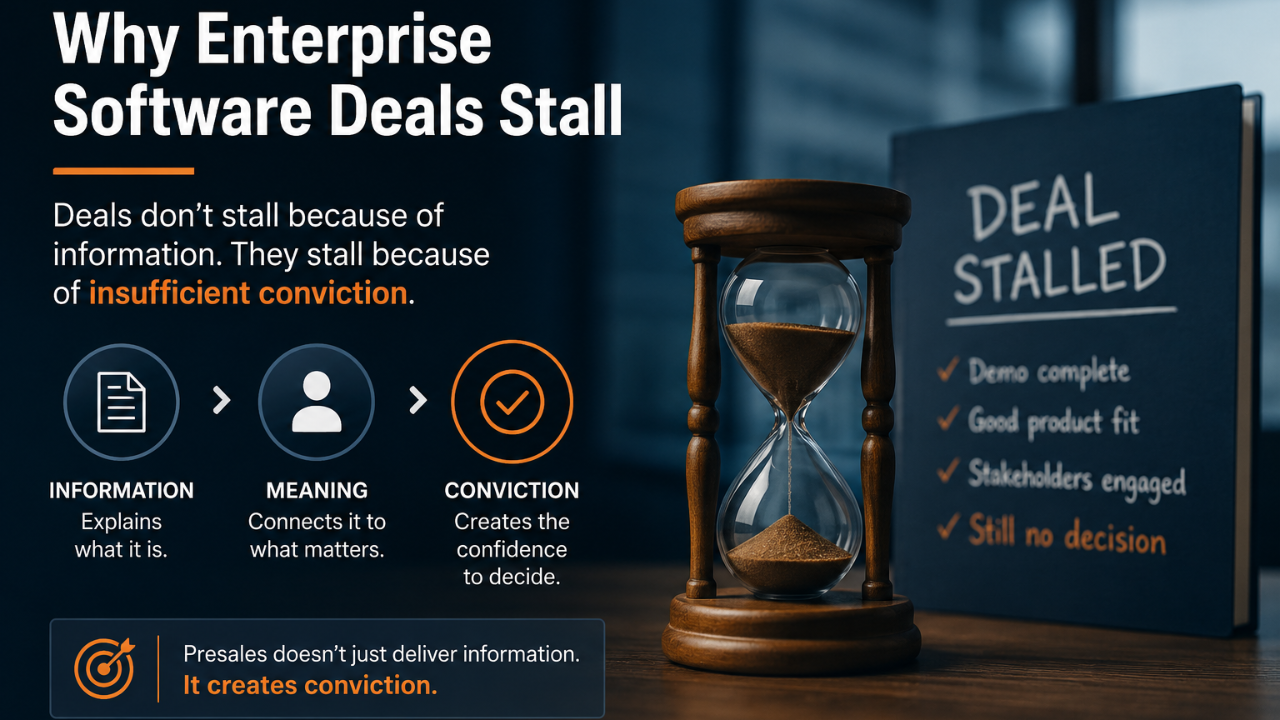
Enterprise software deals rarely stall because buyers lack information.
They stall because buyers lack sufficient conviction to make a decision.
That distinction matters more than most sales teams realize. And understanding it is the difference between a pipeline full of promising opportunities and one full of deals that just... sit there.
The Demo Went Fine. So Why Did the Deal Die?
There's a moment every sales engineer knows.
The demo went well, or at least it seemed to. The prospect was polite. Nobody walked out. A few people even asked questions. And then nothing. Emails go unanswered. The opportunity sits in the pipeline for weeks. The sales rep starts using words like "delayed" and "revisiting" and eventually, "dead."
What happened?
In most cases, it wasn't the product. It wasn't the price. It probably wasn't the competition either.
The deal stalled because the prospect never developed sufficient conviction to move forward. And there are two reasons that happens... one before the demo, one during it.
Cause #1: We Didn't Understand What They Were Actually Trying to Achieve
Most sales engineers walk into a demo knowing what their software can do. Very few walk in with a deep, specific understanding of what this particular customer is trying to accomplish, i.e. what are their actual objectives, their internal pressures, their definition of success, and what's standing between where they are today and where they need to be.
When that understanding is missing, something predictable happens: the demo becomes a tour of features. A technically impressive, well-executed tour. But a tour nonetheless.
And a tour doesn't create conviction. It creates familiarity at best, confusion at worst.
I use an analogy with every group I train:
The person who buys a shovel... Doesn't want a shovel. They want a hole! But they don't just want a hole. They want a fence or a tree. But they don't just want a fence or a tree. They want privacy, or shade, or fruit, or flowers. Yet we have a tendency to show up and talk about the shiny shovel - the blade and the handle. But no one cares all that much about the shiny shovel. They care about what it can do for them. How it will help them achieve what they are trying to achieve. (And those who do care about the shovel... They usually don't have the budget.)
Enterprise software buyers are not excited about the shovel. They're excited (or anxious, or desperate) about what the shovel is supposed to make possible. When we demonstrate features and capabilities without anchoring them to outcomes the buyer actually cares about, we're just showing them a shiny shovel.
The prospect sits through the demo thinking: this seems capable, but does it solve my problem?
If they can't answer that question with confidence, they don't buy. They delay. They go quiet. The deal stalls.
Discovery Is Where Deals Are Actually Won or Lost
The most important thing a sales engineer can do to prevent a deal from stalling isn't in the demo itself. It's in the conversation that happens before the demo.
Most organizations treat discovery as a sales activity. The sales rep qualifies the opportunity, gathers some background, and briefs the SE. The SE shows up prepared to demonstrate the software.
This is a problem.
Not because sales reps do discovery poorly, but because they listen for different things. A sales rep listens for buying signals, budget, and the path to close. That's their job.
A sales engineer needs to listen for something else:
What do I need to say, show, and do (specifically) in order to convince this particular audience that this solution will meet their needs?
Those are different questions. And unless the SE hears the answers directly from the prospect, the demo is built on assumptions.
Effective discovery doesn't just collect requirements. It surfaces consequences, priorities, risk, and decision dynamics.
What are they actually trying to accomplish? And not the RFP language, but the real objective? What happens if they don't solve this problem? Who's in the room, and what does each person need to believe in order to say yes? Is there someone skeptical who's looking for a reason to say no?
These questions change everything about how a demo should be built and delivered. A demonstration built without this context is a well-crafted guess. And in enterprise software sales, where buying committees are large, cycles are long, and a wrong decision is visible to a lot of people, a well-crafted guess isn't enough.
Cause #2: We Informed Them Instead of Convincing Them
Even when discovery is done well, there's a second place where deals stall.
Here's the mindset shift that separates effective presales professionals from the rest:
You are not in the informing business. You are in the convincing business.
These are not the same thing. Informing means showing someone what the software does. Convincing means getting them to believe it will solve their specific problem, deliver the outcome they need, and justify the investment.
The vast majority of enterprise software demos inform. They walk through features, explain capabilities, answer technical questions accurately, and leave the prospect with a thorough understanding of the product. And then the deal stalls.
Understanding is not conviction.
A prospect can understand your software completely and still not be convinced it's the right solution for them, at this moment, for this problem. Conviction requires something more. It requires the prospect to see themselves (their actual situation, their actual problem) reflected in what's being demonstrated. It requires a moment where they think:
Yes, that's exactly what we've been struggling with, and I can see how this changes it.
That moment doesn't happen by accident. It has to be engineered.
This is worth paying attention to as AI becomes more prevalent in the buying process. AI tools make it easier than ever for buyers to access product information, compare capabilities, and conduct research before they ever speak to a sales team. What AI cannot do is help a buyer understand what a solution means for their specific business, their specific situation, and their specific risks. That's a human job. And it's increasingly the most important job in enterprise sales.
What Stalled Deals Are Really Telling You
When a deal goes quiet after a demo, the instinct is to ask:
What did we do wrong?
Sometimes the answer is product fit. Sometimes it's timing or budget. But more often than not, the real answer is this: the prospect left the demo without sufficient conviction to take the next step.
They weren't opposed. They weren't uninterested. They just weren't convinced enough to act.
In most cases, it traces back to one of these:
- The demo addressed the wrong things, because discovery was shallow or secondhand
- The demo addressed the right things, but framed them around the software rather than the prospect's outcomes
- The prospect's real concern, i.e. the thing actually blocking the decision, was never surfaced or addressed
- The right people weren't in the room, or the person who was there didn't have the authority to move forward
Every one of these is preventable. None of them require a better product.
The Fix Is Not a Better Demo
The solution to stalled deals is not a more polished demo. It's not better slides, smoother delivery, or more impressive visuals.
The solution is a more disciplined process. One that starts well before the first click and is built around a clear understanding of what this specific prospect needs to see, hear, and believe in order to move forward.
That means investing in discovery before every meaningful opportunity. It means building demos around prospect outcomes, not product capabilities. It means walking into every customer conversation with a single clear goal: not to show what the software does, but to create the conviction that it will solve their problem.
When that discipline is present, deals don't stall. Prospects have what they need to make a decision. And more often than not, they make one.
The Bottom Line
Enterprise software deals stall for a predictable reason: the prospect never developed sufficient conviction to move forward.
Not because the product wasn't good enough. Not because the demo wasn't professional. But because somewhere between discovery and delivery, the connection between what the software does and what the prospect actually needs got lost.
The sales engineers and presales teams who consistently avoid this outcome aren't necessarily more talented. They're more disciplined. They treat discovery as their responsibility. They build demos around outcomes, not features. And they measure success not by how smooth the demo was, but by whether the prospect left with the conviction to take the next step.
That's the job. And it's a learnable discipline.