
What is Value-Based Discovery?
Apr 08, 2026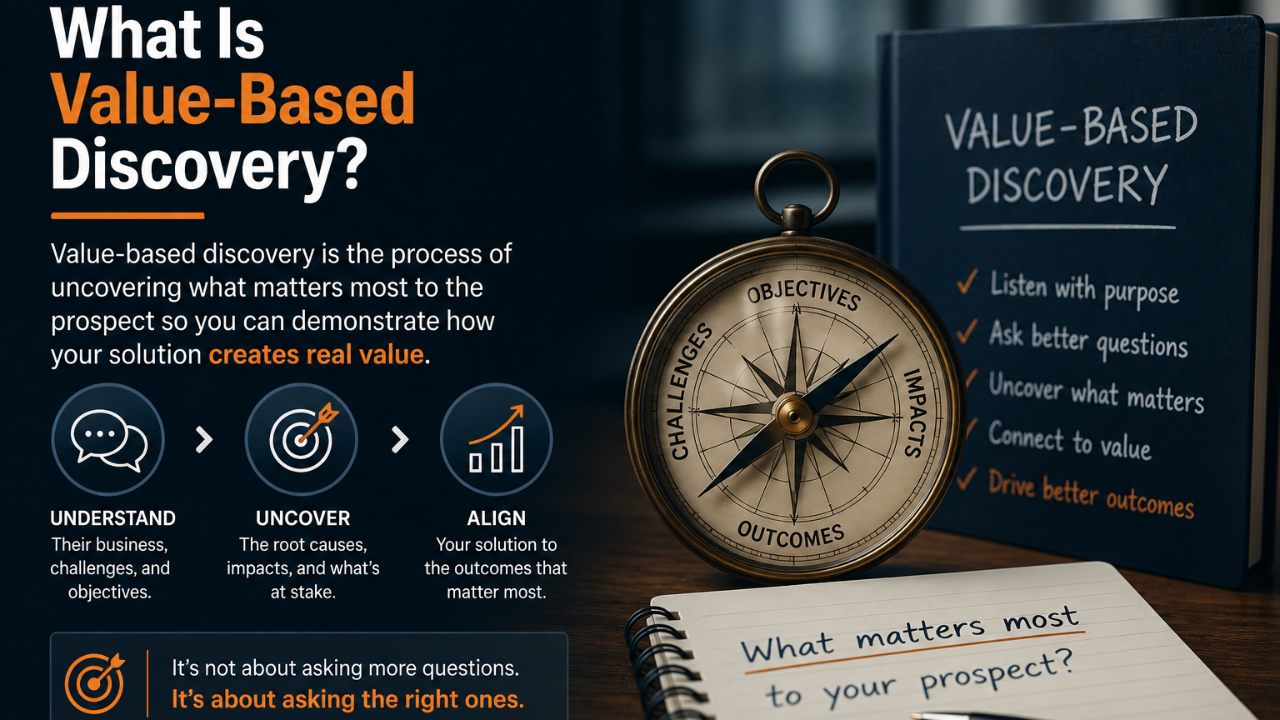
Most discovery conversations don’t fail because the questions are bad.
They fail because the intent is wrong.
In enterprise B2B software sales, discovery is often treated as a process for gathering information, i.e. requirements, pain points, use cases.
But information alone doesn’t move a deal forward.
Buyers rarely struggle to describe their situation.
They struggle to understand it clearly enough to act on it.
Discovery is not about collecting answers. It's about shaping how the buyer understands the problem.
Value-Based Discovery in One Sentence
Value-based discovery is the process of shaping how the buyer understands the problem, its impact, and the cost of inaction, so a decision becomes both clear and necessary.
What Is Value-Based Discovery?
Value-based discovery is the discipline of guiding how a buyer:
- defines the problem
- evaluates its business impact
- understands the consequences of not solving it
In complex enterprise environments, buyers are not simply identifying needs.
They are:
- reconciling competing priorities
- navigating internal stakeholders
- assessing risk
- justifying investment
They are trying to answer:
- Is this problem important enough to solve now?
- What happens if we don’t?
- Is this worth the disruption?
Value-based discovery helps them arrive at those answers with clarity.
Not by telling them.
By helping them see it for themselves.
What Value-Based Discovery Actually Does
The visible activity of discovery is familiar:
- asking questions
- taking notes
- documenting requirements
But those activities are not the function.
The function is what happens beneath them:
- transforming vague problems into defined business issues
- connecting technical challenges to business outcomes
- elevating perceived impact
- creating urgency where none previously existed
Discovery creates meaning.
And meaning is what drives decisions.
The Core Distinction: Information vs Meaning
The most common mistake in discovery is treating it as information gathering.
In reality, the distinction is this:
- Information answers questions
- Meaning drives decisions
A buyer can have all the information in the world... and still not act.
Because information does not create urgency.
Meaning does.
Value-based discovery is the bridge between the two.
It transforms:
- data into insight
- insight into relevance
- relevance into urgency
Without that transformation, discovery becomes documentation.
And documentation does not close deals.
Where Discovery Performance Breaks
Discovery underperforms when it is treated as a checklist instead of a strategic conversation.
Common failure patterns:
- Questions are asked, but not connected to business impact
- Answers are accepted at face value, without deeper exploration
- Discovery is rushed to “get to the demo”
- Technical details are gathered, but business context remains unclear
- The buyer’s understanding of the problem never evolves
The result is predictable:
- Demos lack relevance
- Value is assumed rather than established
- Objections emerge late
- Deals stall without a clear reason
The issue is not lack of information.
It is lack of meaning and urgency.
The Leadership Implication
Organizations that treat discovery as a qualification step optimize for speed.
Organizations that treat discovery as a value-creation process optimize for outcomes.
Value-based discovery:
- increases deal quality
- improves demo relevance
- surfaces risk earlier
- strengthens stakeholder alignment
- accelerates decision-making
It is the foundation of predictable revenue performance in complex enterprise sales.
Discovery in the Age of AI
Artificial intelligence is accelerating how information is gathered and processed across the buying process.
AI can:
- suggest discovery questions
- summarize prior conversations
- identify patterns across deals
But it also creates a new risk.
It gives teams the illusion that they are prepared, when they may not be aligned.
Discovery doesn’t fail because we didn’t ask enough questions.
It fails because we didn’t help the buyer think differently.
AI accelerates information gathering.
It does not replace judgment, perspective, or the ability to create meaning.
Frequently Asked Questions
What is the difference between value-based discovery and traditional discovery?
Traditional discovery focuses on gathering information: requirements, pain points, and use cases.
Value-based discovery focuses on shaping how the buyer understands the problem, its impact, and the cost of inaction.
One documents the situation. The other drives the decision.
Is value-based discovery the same as asking better questions?
No. Better questions help, but the objective is not the question. It is how the buyer’s understanding evolves as a result of the conversation.
Who owns discovery? The AE or SE?
In modern presales, discovery is shared. AEs often lead commercial context. SEs deepen technical and operational discovery. Both contribute to shaping the buyer’s perspective.
When should discovery happen?
Earlier than most teams assume. Discovery begins at the first meaningful interaction and continues throughout the sales process. It is not a one-time event.
Why do discovery conversations fail?
Most discovery conversations fail because they stop at information.
The buyer answers questions, but their understanding of the problem doesn’t change.
Without a shift in how the problem is perceived — its impact, urgency, or priority — there is no reason to act.
Discovery fails when it documents the situation instead of shaping the decision.
Summary
Value-based discovery is not about gathering requirements.
It is about shaping how the buyer understands the problem, its impact, and the cost of inaction.
It turns information into clarity. Clarity creates urgency. And urgency is what drives decisions.