
What is Sales Engineering?
Feb 25, 2026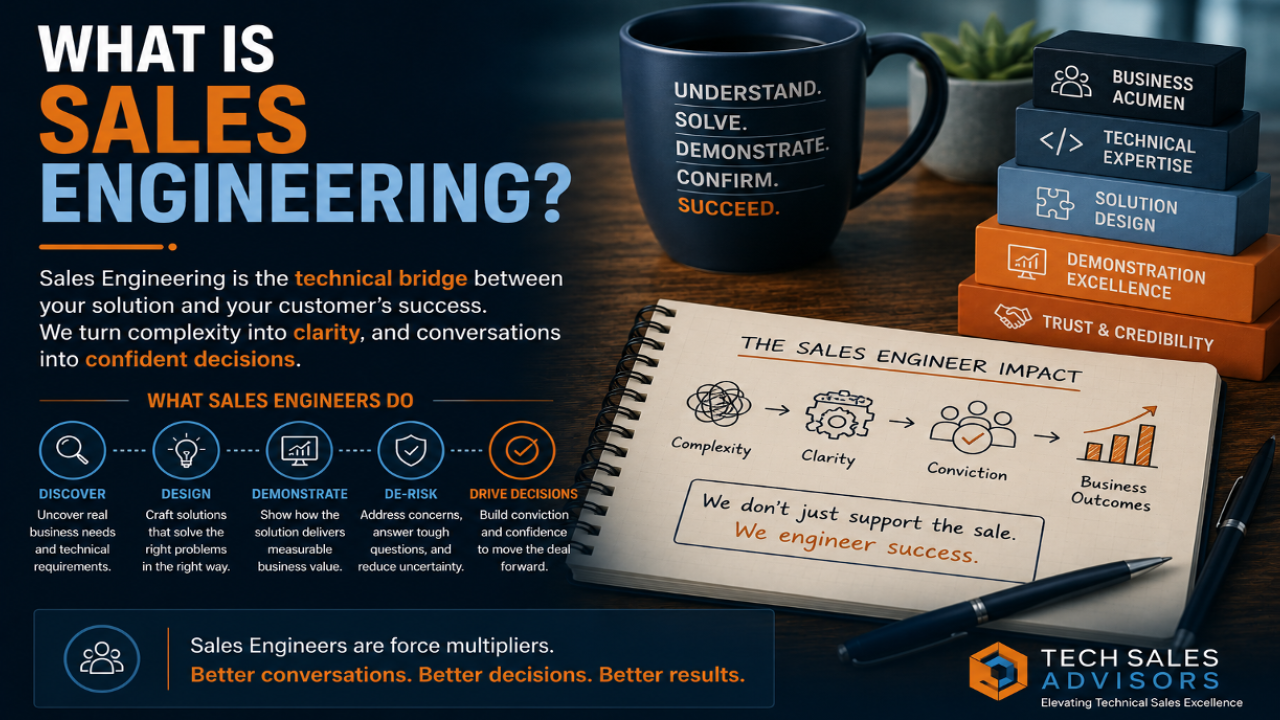
Sales engineering, often referred to as presales, is the function within enterprise B2B software sales responsible for disciplined discovery, solution alignment, and buyer confidence prior to contract signature.
In complex software environments, buyers are not simply evaluating features. They are evaluating feasibility, integration risk, scalability, operational impact, and long-term viability.
Sales engineering exists to answer a critical question:
Will this solution work in our environment and help us achieve our desired outcomes?
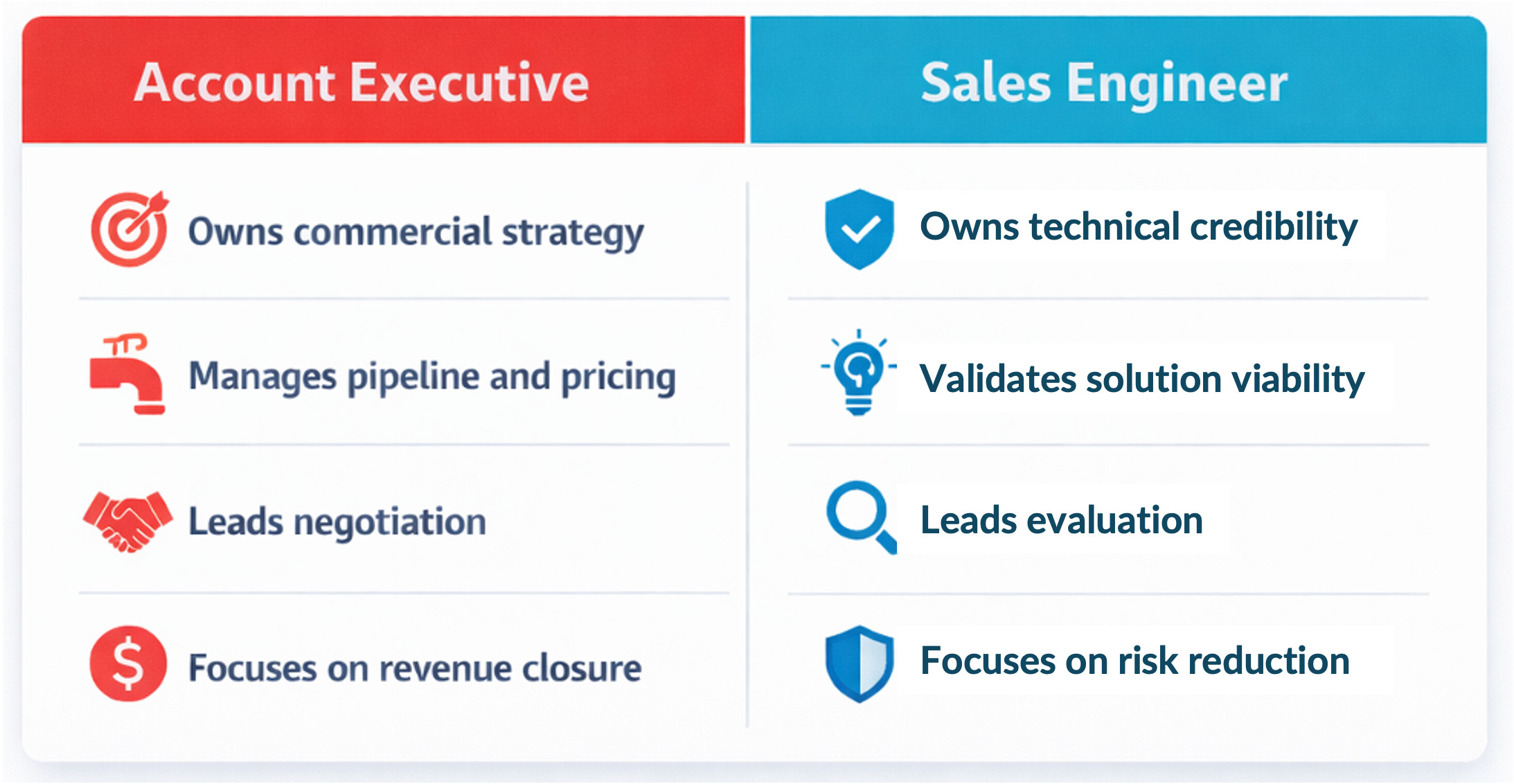
While the Account Executive drives commercial momentum, the Sales Engineer leads business and technical validation. In enterprise sales, both roles are revenue-critical and operate in parallel.
Sales engineering bridges commercial promise and technical reality. It translates product capability into applied relevance and reduces uncertainty during the evaluation process.
Sales Engineering in One Sentence
Sales engineering translates complex technology into confident buying decisions.
What Does a Sales Engineer Do?
A Sales Engineer in enterprise software environments typically:
- Conducts value-based technical discovery
- Designs and delivers strategic solution demonstrations
- Validates feasibility within the buyer’s architecture
- Identifies integration, security, and scalability risks
- Translates product capabilities into business outcomes
- Clarifies risk in complex buying decisions
High-performing Sales Engineers influence whether enterprise opportunities advance, or stall.
Sales Engineer vs Account Executive
Modern enterprise sales require both Account Executives (sales) and Sales Engineers (presales) to operate in alignment. The division of roles typically reflects commercial ownership on one side and technical validation on the other.
Sales engineering ensures the buyer believes the solution will work in their environment.
Belief drives buying behavior.
Why Sales Engineering Matters in Modern Enterprise Sales
Enterprise buying environments are:
- Multi-stakeholder
- Risk-sensitive
- Technically complex
- Financially scrutinized
In these environments, product features alone are insufficient.
Effective sales engineering provides:
- Contextual relevance
- Strategic clarity
- Risk mitigation
- Executive confidence
Without effective sales engineering, enterprise sales default to feature comparisons rather than outcome-driven decisions.
Sales Engineering and Revenue Impact
Although Sales Engineers may not always carry a quota, their impact on revenue is measurable.
Effective sales engineering influences:
- Win rates
- Deal size
- Sales cycle duration
- Competitive differentiation
- Executive alignment
When technical validation is strong, commercial negotiations accelerate.
When technical validation is weak, deals stall.
In complex B2B software environments, revenue depends on both commercial strategy and technical conviction.
The Evolution of Sales Engineering
Traditional sales engineering focused on:
- Product expertise
- Feature demonstration
- Technical explanation
Modern sales engineering requires:
- Value-based discovery
- Business impact articulation
- Executive communication
- Emotional maturity
- AI-augmented preparation
- Cross-functional collaboration
The modern Sales Engineer is not simply a technical resource.
They are a performance-driven advisor within complex enterprise systems.
The Six Habits of Highly Effective Sales Engineers
High-performing sales engineering requires discipline.
The Six Habits framework, developed by Chris White, defines the behavioral patterns of high-performing Sales Engineers:
- Partner – Sales is a team sport
- Probe – Seek to understand before attempting to explain
- Prepare – Focus on narrative, not content
- Practice – Rehearse delivery consistently
- Perform – Execute with presence and clarity
- Perfect – Treat every meeting as an opportunity to improve
These habits structure sales engineering around performance, not just product knowledge.
Sales engineering excellence is not accidental.
It is systematic.
Sales Engineering in the Age of AI
Artificial intelligence is reshaping presales workflows.
AI can:
- Generate demo scripts
- Analyze call transcripts
- Summarize discovery conversations
- Identify competitive positioning gaps
AI cannot:
- Establish trust
- Interpret executive hesitation
- Navigate internal politics
- Exercise contextual judgment
High-performing presales integrates human-centered selling with AI-augmented preparation and coaching.
Sales engineering is evolving, not disappearing.
Frequently Asked Questions
Is sales engineering the same as presales?
In most enterprise software organizations, yes. The terms are often used interchangeably to describe the function responsible for technical validation before contract signature.
Do Sales Engineers influence revenue?
Absolutely. While compensation structures vary, Sales Engineers directly influence buyer confidence, competitive positioning, and technical validation, all of which affect win rates and deal outcomes.
Who owns discovery? Account Executive or Sales Engineer?
Discovery is shared. Account Executives often lead commercial qualification, while Sales Engineers deepen technical and operational discovery to ensure feasibility and alignment.
Summary
Sales engineering, also known as presales, is the discipline responsible for translating technical complexity into buyer confidence.
It bridges commercial intent and technical reality.
It requires technical expertise, business fluency, emotional intelligence, disciplined execution, and AI-augmented readiness.
In complex enterprise software sales, revenue acceleration requires both commercial momentum and technical conviction. High-performing Sales Engineers drive both.
To explore structured training for modern sales engineering teams, learn more about our programs here.