
What Is Presales? How It Works in Modern B2B Software Sales
Mar 23, 2026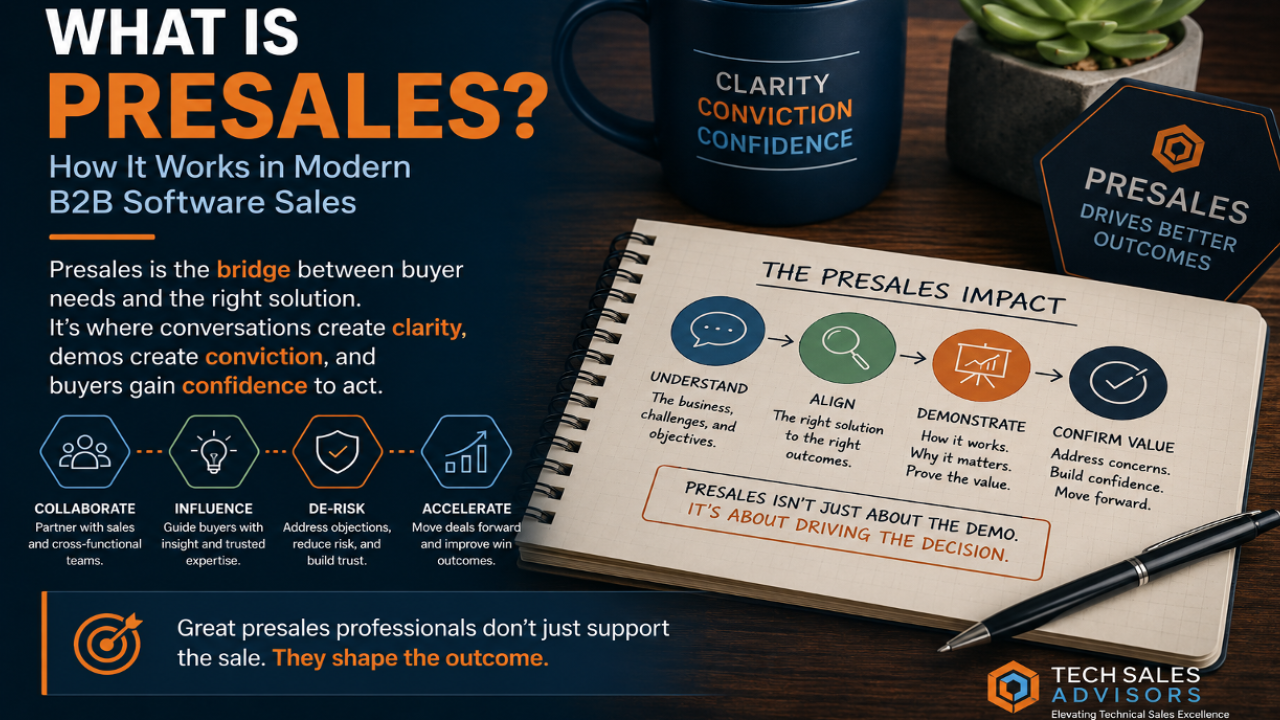
Most organizations manage presales as if it were a stage in the sales process.
It isn’t.
Presales is not a moment that occurs between qualification and contract. It is the function within enterprise B2B software sales responsible for transforming technical possibility into confident buying decisions - before, during, and after the formal evaluation.
The confusion is expensive. When revenue leaders treat presales as a stage, they optimize for the wrong things: demo quality, POC completion, technical coverage. They measure activity instead of decision influence.
The most important work done by presales, does NOT happen in the CRM.
It happens in the buyer’s mind.
Presales in One Sentence
Presales is the function that converts technical complexity into commercial conviction.
What Is Presales?
Presales, often used interchangeably with sales engineering, is the discipline responsible for guiding how buyers understand, evaluate, and gain confidence in a complex technical decision.
In enterprise B2B software, buyers are not simply choosing between products. They are evaluating feasibility, risk, integration complexity, and organizational impact. They are asking:
- Will this solution work in our environment?
- Does it align to our strategic objectives?
- What is the risk of getting this wrong?
Presales exists to answer those questions, not with more information, but with clarity, structure, and conviction.
Where the Account Executive advances commercial momentum, presales advances technical conviction. Both are required. Neither is sufficient alone.
Technical conviction is not developed in isolation, it is coordinated with commercial strategy and shaped by human judgment throughout the buying process.
What Does Presales Actually Do?
The visible outputs of presales are familiar:
- Discovery conversations
- Solution demonstrations
- Proof of concept design and execution
- Technical validation and risk assessment
But the visible outputs are not the function.
The function is what happens beneath those activities:
- Reframing how the buyer understands the problem
- Reducing uncertainty before it becomes objection
- Shaping how internal stakeholders evaluate tradeoffs
- Building the conviction required to approve significant investment
Presales doesn’t explain the product. It guides the decision.
The Core Distinction: Stage vs. System
The most common misunderstanding of presales is structural: it is treated as a stage, something that activates during the demo or POC window.
In reality, presales is a system. It operates continuously throughout the buying process.
- Before the first demo: Presales shapes how the problem is framed, what questions get asked, and which stakeholders are engaged.
- During evaluation: Presales manages uncertainty, reduces risk, and builds stakeholder alignment.
- After the demo: Presales guides interpretation, supports internal selling within the buyer’s organization, and drives the next decision step.
Presales is not activated when the demo begins. It is the mechanism through which technical possibility becomes a viable, believable business decision.
Where Presales Performance Breaks
Presales underperforms when it is managed as support capacity rather than a value-creation function.
Common failure patterns:
- Presales is deployed reactively, after commercial strategy is already set, rather than as a co-architect of the deal approach
- Success is measured in demos delivered and POCs completed rather than in decision progression
- The Sales Engineer’s role is confined to technical Q&A rather than decision guidance
- Buyers receive more information instead of clearer answers
The result is predictable: deals accumulate objections, lose internal champions, or stall without explanation.
The problem is rarely the product. It is the absence of conviction within the buying organization.
The Leadership Implication
Revenue leaders who manage presales as a support function are optimizing for efficiency. They should be optimizing for impact.
Presales manufactures confidence. In enterprise software sales, confidence is what unlocks budget approval, accelerates stakeholder alignment, and compresses the path to decision.
Organizations that invest in presales as a performance discipline, not just a technical resource, create a structural revenue advantage: their buyers decide faster, with greater confidence, and with less residual risk.
Presales in the Age of AI
Artificial intelligence is accelerating information access across the buying process.
AI can:
- Generate discovery frameworks
- Summarize technical documentation
- Analyze competitive positioning
- Produce demo scripts and presentation content
AI cannot:
- Interpret executive hesitation
- Navigate internal politics
- Reframe a buyer’s mental model of the problem
- Build the human trust required for significant investment
As information becomes more abundant, the scarcity shifts. Buyers are not struggling to find information. They are struggling to find conviction.
Presales becomes more valuable in an AI-enabled environment, not less, because its primary output is the one thing AI cannot manufacture.
Frequently Asked Questions
Is presales the same as sales engineering?
In most enterprise software organizations, yes. The terms are used interchangeably to describe the function responsible for technical validation and solution conviction prior to contract signature.
When does presales begin?
Earlier than most organizations assume. Effective presales begins influencing deal outcomes at the discovery stage, shaping how the problem is framed and what the buyer believes is possible, well before any formal demonstration.
How is presales different from sales support?
Sales support is typically reactive and logistical. Presales is a strategic function responsible for building technical conviction in the buyer’s organization. The distinction is the difference between capacity and impact.
Does presales directly affect revenue?
Yes. Presales directly influences win rates, deal size, and sales cycle duration. When technical conviction is strong, commercial negotiations accelerate. When it is absent, deals stall regardless of commercial momentum.
Summary
Presales is not a stage in the sales process. It is the function responsible for transforming technical complexity into confident buying decisions.
It operates before, during, and after the formal evaluation. Its output is not simply demos and POCs, it is the clarity, conviction, and stakeholder alignment that enterprise buyers need to make significant decisions.
Executives think presales delivers information. In reality, presales creates conviction.
And conviction, not information, is what drives enterprise revenue.