
Sales Engineer vs Account Executive: Who Owns What in Enterprise Revenue?
Mar 09, 2026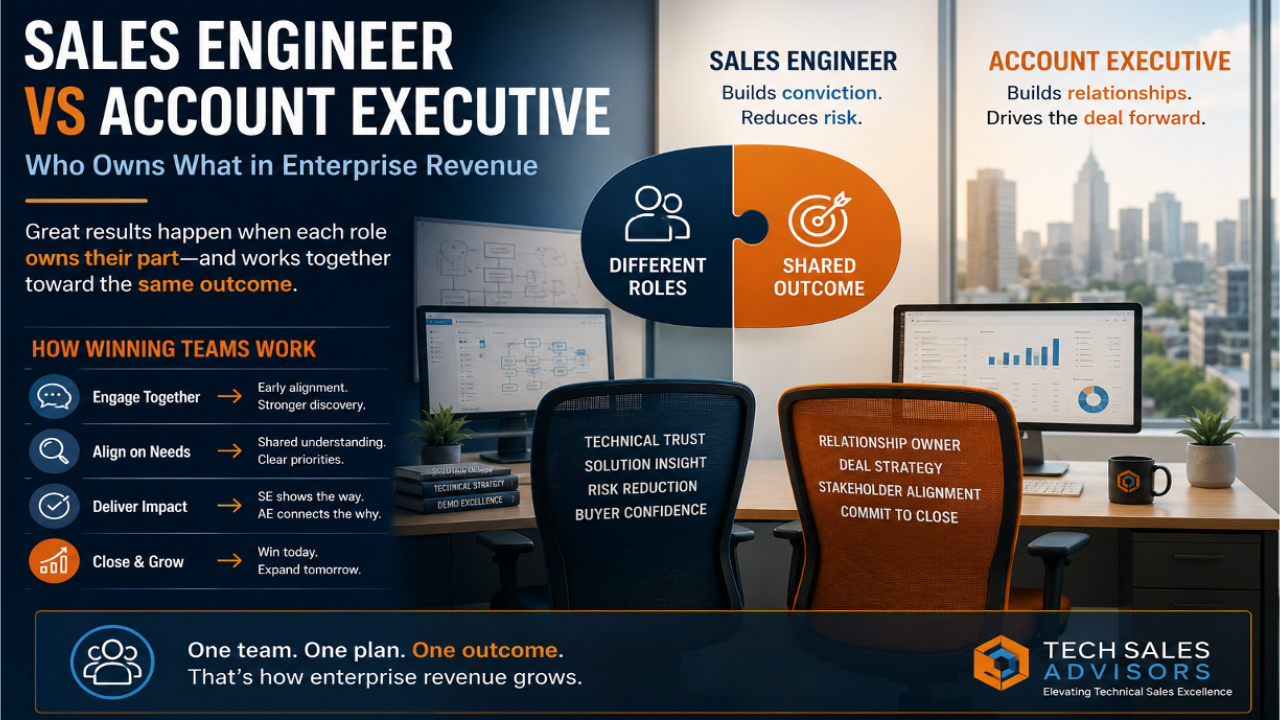
In enterprise B2B software, stalled deals are rarely pure product failures or talent failures. They are coordination failures.
Teams typically don't lose simply because the Account Executive lacked drive or Sales Engineers lacked expertise. They lose because ownership between commercial and technical influence is structurally misunderstood and/or poorly executed.
Particularly in complex B2B software sales, which involve numerous stakeholders, long sales cycles, and significant investment on both sides, trust, clarity, collaboration between the AE and SE roles are not administrative. They are strategic.
Two Roles. One Revenue Goal.
Sales is a team sport. In enterprise software, the scoreboard is revenue, and both the AE and SE have a direct hand in the final score.
In enterprise B2B software sales:
The Account Executive (AE) owns commercial strategy and revenue advancement.
The Sales Engineer (SE) owns technical credibility and solution conviction.
Both roles are revenue roles.
They simply influence revenue in different ways.
Enterprise revenue is not created by hierarchy.
It is created by alignment.
Modern presales performance is the structured alignment of commercial strategy, technical credibility, and executive engagement to accelerate enterprise revenue in complex B2B software environments.
What Is the Difference Between a Sales Engineer and an Account Executive?
The difference is not seniority or importance.
It is ownership of influence.
The Account Executive advances the deal commercially: pipeline creation, economic buyer engagement, negotiation, and revenue commitment.
The Sales Engineer advances the deal technically: solution validation, risk reduction, integration feasibility, and stakeholder confidence.
In modern enterprise sales, revenue acceleration requires both commercial momentum and technical conviction. When either weakens, deal velocity suffers.
The Core Distinction: Influence Domains
At a high level:
The Account Executive is responsible for commercial momentum.
The Sales Engineer is responsible for technical conviction.
Enterprise deals close when both are strong.
Deals stall when either is weak.
Revenue Responsibility Is Shared
It is outdated to say:
“The AE carries the quota and the SE supports.”
In complex enterprise software sales:
- AEs drive opportunity creation and commercial progression.
- SEs drive technical validation and risk mitigation.
- Both directly influence win rates.
- Both influence deal size.
- Both influence sales cycle duration.
Compensation structures may differ.
Revenue impact does not.
Customer confidence is a shared outcome.
Functional Ownership Breakdown

Technical uncertainty can derail enterprise revenue just as quickly as commercial friction.
Where Enterprise Deals Actually Break
Enterprise deals most often fracture at one of three seams:
- Misaligned expectations between commercial promise and technical reality
- Incomplete discovery of business impact
- Unaddressed integration, scalability, or operational risk
These are not purely “sales problems” or “technical problems.”
They are alignment problems.
The fracture points are predictable. Which means they are preventable, IF both roles understand where coordination breaks down before it does.
Enterprise revenue performance is a coordinated system.
When coordination fails, even strong individuals lose.
The Revenue Multiplier Effect
When AEs and SEs operate in intentional partnership:
- Discovery depth increases
- Demo relevance improves
- Objections surface earlier
- Executive conversations strengthen
- Sales cycles compress
- Win rates rise
Intentional partnership doesn’t just improve outcomes. It compresses the timeline to get there.
When they operate in silos:
- Demos feel disconnected from strategy
- Commercial commitments outpace feasibility
- Risk appears late
- Trust erodes
Misalignment rarely announces itself. It shows up quietly, in deals that slow down for no obvious reason.
Alignment is a revenue multiplier.
The Modern Shift in Role Expectations
Traditional model:
- AE sells.
- SE demos.
Modern enterprise model:
- AE leads commercial orchestration.
- SE leads solution strategy.
- Both articulate business value.
- Both engage executive stakeholders.
In modern presales performance, the Sales Engineer is not a technical responder.
They are a strategic performance partner.
AI and the AE–SE Dynamic
Artificial intelligence is accelerating workflow speed, but it does not reduce role interdependence.
AI can:
- Draft follow-up communication
- Analyze call transcripts
- Generate demo frameworks
- Surface competitive insights
AI cannot:
- Replace strategic coordination
- Navigate political dynamics
- Align commercial positioning with technical feasibility
- Build executive trust
As AI accelerates tactical execution, structural clarity between AE and SE becomes more, NOT less important.
The faster workflows move, the more disciplined coordination must become.
Frequently Asked Questions
Does a Sales Engineer carry revenue responsibility?
Yes. While quota ownership may differ, Sales Engineers directly influence win rates, deal size, and buyer confidence in enterprise software sales.
Can enterprise deals close without strong technical influence?
In complex B2B environments, rarely. Technical credibility is foundational to executive decision-making.
Who owns discovery, AE or SE?
In modern presales performance, discovery is shared. AEs often lead commercial qualification. SEs deepen technical and operational discovery to uncover business impact and risk exposure.
Is the Sales Engineer a support role?
In high-complexity enterprise sales, no. The SE is a strategic partner responsible for solution conviction and risk reduction.
Summary
The Account Executive drives commercial momentum.
The Sales Engineer drives technical conviction.
Revenue acceleration requires both.
Enterprise deals are won when commercial strategy and technical credibility operate in alignment.
Modern presales performance is not about hierarchy.
It is about intentional partnership.